Across the Middle East, a quiet environmental revolution is happening. The regions that used to struggle and were once dominated by the sprawling landfills and waste management challenges are being transformed through innovative bio-remediation and sustainable waste management technologies. These landmark projects not only address environmental concerns but also reimagine the whole idea of what’s possible when the involvement of science, policy, and community engagement converges to heal the landscapes once taken by waste accumulation for decades.
The Middle East faces unique waste management challenges due to its rapid urbanisation, population growth and limited usable land. However, over the years, several countries have pioneered remarkable landfill transformation initiatives that not only impact the environment positively but also serve as examples of eco-friendly environmental practices. For Instance, Israel’s conversion of the region's largest landfill into a thriving environmental park, while Saudi Arabia’ developing innovative bioremediation facilities and establishing waste-to-energy plants in the UAE, etc., these success stories demonstrate the immense and positive impact of environmental recovery efforts.
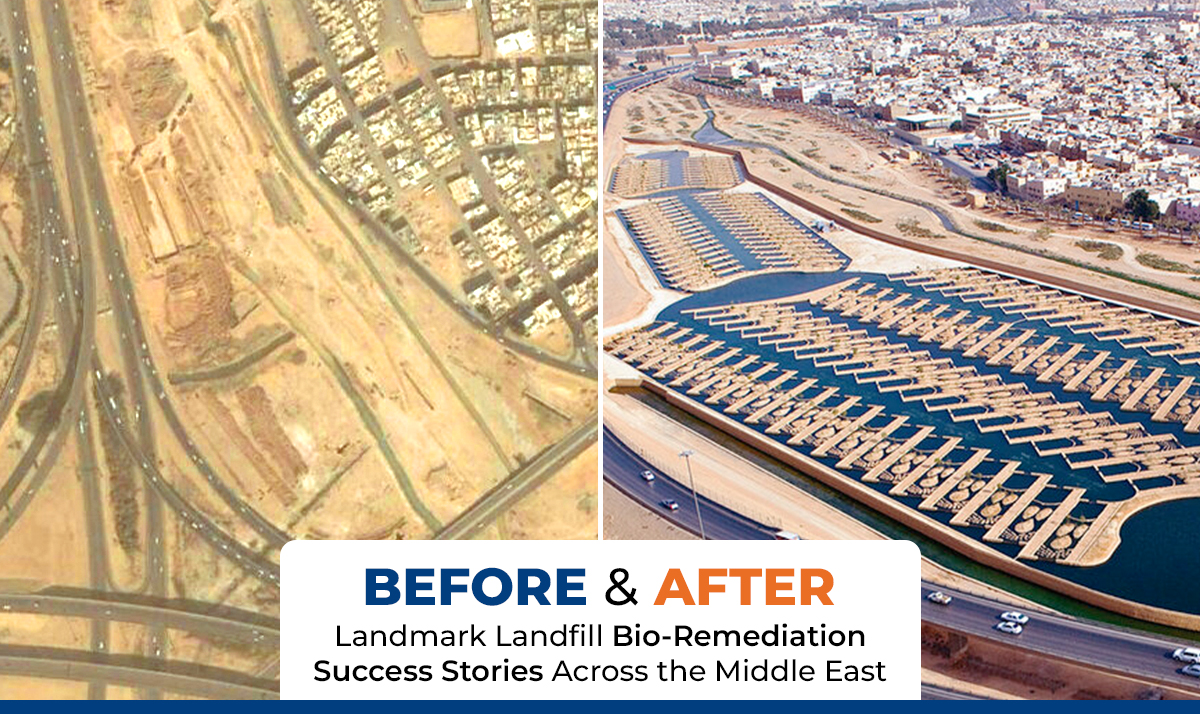
Wadi Hanifah: Saudi Arabia's Pioneering Bio-Remediation Marvel
The Challenge
Wadi Hanifah, an important natural landmark of Saudi Arabia's Najd plateau, serves as the role of primary drainage channel to Riyadh, where around 70% of the city lies in its catchment area. The rapid growth of Riyadh by the 1980s had significantly degraded this important ecosystem. The waste table dropped below sustainable levels, thus desalinated water had to be piped in from the Eastern Province through pipelines. At the same time, the illegal dumping of industrial and urban waste made the situation even worse by creating serious health risks and contributing to the worsening condition of ecological deterioration of the river corridor.
The Transformation
The Riyadh Bioremediation Facility, completed in 2009 for $32 million, is one of the most ambitious environmental recovery projects in the region. The landmark project did not merely restore a brownfield site but transformed it into the world’s largest wastewater bioremediation facility of its kind.
The facility used a food chain-based approach, in which the primary producers (algae and higher plants), along with the consumer organisms (fish, birds, insects), break down components of the urban wastewater. The system has:
The Results
The project demonstrates how bio-remediation simultaneously addresses the environmental degradation, water scarcity and public health concerns while also creating new recreational spaces for the community. The environmental impact has been remarkable:
Sharjah's Zero-Waste Revolution: Transforming Landfills Through Innovation
The Challenge
Sharjah, the emirate in the GCC region, had to deal with similar problems of mounting mountains of waste management and lack of landfill space as other fast-growing cities in the Gulf, and, eventually, it went through a process of transformation in its waste disposal system. With limited land availability and growing environmental concerns, traditional landfilling methods for waste disposal are becoming increasingly unsustainable.
The Transformation
BEEAH Group, in collaboration with Masdar, has developed a unique landfill transformation strategy centring on the Sharjah Waste to Energy plant. The state-of-the-art facility, which was inaugurated in May 2022, is the first of its kind in the Middle East and has already become an integral part of Sharjah's zero-waste-to-landfill initiative.
The plant utilises modern thermal treatment technology as its core process:
The Results
This project demonstrates how integrated waste management approaches can transform landfills into valuable energy resources while significantly reducing environmental impact. The impact concerning landfill diversion and environmental recovery has been huge:
The landmark landfill bio-remediation success stories across the Middle East highlight the region’s commitment and dedication to environmental recovery and sustainable development. These projects, which include the transformation of Hiriya in Israel, the bioremediation facility in Riyadh, and the inventive waste management methods adopted in the GCC countries, showcase the significant potential of integrating science innovation, policy support, and community engagement.
Indeed, the case studies of environmental recovery provide valuable takeaways not only for the particular localities where they were executed but for global projects around the world, especially in areas where the problems of water shortage, fast urbanisation and limited land resources. The process of converting the former environmental liabilities to community assets not only signifies technological accomplishment but a fundamental transformation of the waste how societies perceive it, that is, not as an unavoidable burden but recognised as a potential resource for recovery and reuse.
As the Middle East steadily continues to develop and implement landfill transformation projects, the region is positioning itself as a global leader in worldwide environmental remediation and circular economy approaches. These initiatives not only tackle the immediate environmental problems but also contribute to a broader goal of sustainability, resource efficiency, and the overall improvement of quality of life for both current and future generations. The journey from mountains of waste to flourishing ecosystems, from contaminated legacy sites to community-based ecosystems, and from linear waste streams towards biological and resource loops and energy, is a dynamic story of landfill bio-remediation strategies in the Middle East.
 Food Waste
 Livestock Waste Solutions
 Agri Waste
 Waste To Energy Solutions
 Plastic Waste Solutions
 MSW Solutions
 Legacy Waste Solutions
 E-Waste Solutions
 Industrial Waste Management Solutions
 Hazardous Waste Solutions
 Restoration & Recovery Solutions
 Education & Awareness Solutions